Resurrection Plants: Masters of Botanical Survival
February 20, 2026
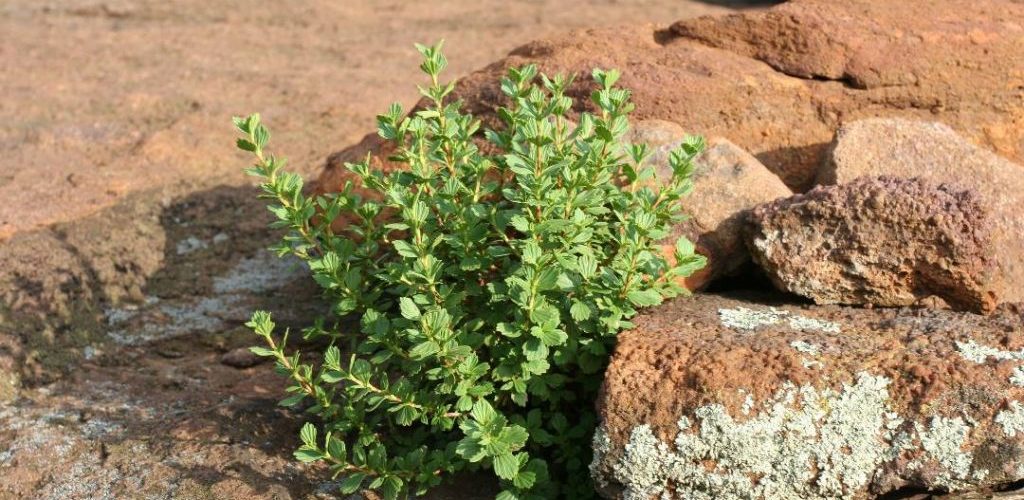
The ability to survive almost complete desiccation seems incompatible with life. For most plants, losing even half of their internal water content is critical: membranes lose integrity, photosynthesis halts, and cellular damage becomes irreversible. Yet in nature, there are species capable of losing up to 95–98% of their water, entering a state of deep metabolic suspension, and then recovering after the first rainfall. Plants with pronounced desiccation tolerance represent a rare but profoundly important phenomenon for understanding evolution, ecosystem resilience, and the future of agriculture under drought conditions.
The Biology of “Resurrection”: Limits of Physiological Plasticity
Desiccation tolerance is the ability to withstand extreme dehydration without lethal damage to tissues or irreversible disruption of cellular structures. In most vascular plants, such mechanisms exist only at the seed stage. A seed can dry out, remain dormant through unfavorable periods, and germinate years later. However, transferring this strategy to the adult vegetative stage is an exceptionally rare evolutionary achievement.
Out of more than 390,000 vascular plant species worldwide, only about 130–150 species are known to tolerate near-total desiccation in their mature state. This represents less than one tenth of one percent of total plant diversity. This is not simply enhanced drought resistance — it is a fundamentally different physiological strategy.
 What Happens Inside the Cell During Drying
In ordinary plants, dehydration leads to membrane collapse and protein denaturation. In resurrection plants, a coordinated protective program is activated:
-
Osmoprotective sugars (such as sucrose and trehalose) accumulate to stabilize membranes.
-
LEA (Late Embryogenesis Abundant) proteins prevent enzyme aggregation.
-
Antioxidant systems intensify to control oxidative stress.
-
Leaves curl or fold, reducing surface area and minimizing photodamage.
This is not passive drying, but a regulated transition into a state of biological preservation.
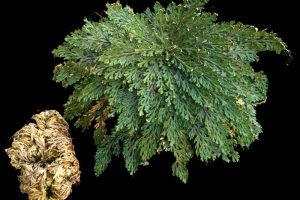
One of the most iconic examples is Selaginella lepidophylla, which curls into a tight ball when dry, drastically reducing metabolic activity. Upon rehydration, it unfolds and resumes photosynthesis within hours.
A key molecular model species is Craterostigma plantagineum, in which dozens of genes are activated during dehydration. Research on this species has demonstrated that tolerance results from complex regulatory networks rather than the action of a single gene.
Particularly remarkable is the woody shrub Myrothamnus flabellifolia. Woody tissues are typically highly sensitive to dehydration, yet this species can repeatedly survive complete desiccation, expanding our understanding of the physiological limits of vascular plants.
In Europe, the relic species Haberlea rhodopensis survives in rocky crevices of the Balkan Mountains, showing that resurrection strategies are not confined to tropical climates.
Among species with particularly pronounced tolerance is Xerophyta viscosa, capable of enduring repeated dehydration cycles without permanent damage to its photosynthetic apparatus.
Evolution and Ecology of a Rare Strategy
If desiccation tolerance is so effective, why is it so rare?
The answer lies in its energetic cost. Maintaining readiness for complete desiccation requires continuous regulation of complex genetic systems. In stable climates, such a strategy becomes excessive and metabolically expensive. It is often more advantageous to develop deep roots, seasonal dormancy, or rely on seed-based survival.
Plants with pronounced desiccation tolerance are most commonly found in:
-
Rocky substrates with minimal water retention
-
Savannas with sharply seasonal rainfall
-
Desert and semi-desert environments
-
Mountainous regions with rapid soil drying
In such habitats, water availability is sudden and short-lived. Rapid reactivation of photosynthesis provides a competitive advantage. While other plants are only beginning to resume growth, resurrection species are already exploiting available moisture.
The strategy is justified in environments with sharp fluctuations in moisture and is rarely found in stable climates. This explains why, among hundreds of thousands of vascular plants, only about 130–150 species have evolved such an extreme survival mechanism.
Scientific and Practical Significance
With ongoing climate change, interest in resurrection plants has intensified. Drought is becoming one of the primary drivers of reduced agricultural productivity. Understanding the molecular and physiological mechanisms of desiccation tolerance offers potential pathways for improving crop resilience.
Core Mechanisms and Their Potential Applications
| Mechanism | Biological Function | Potential Application |
|---|---|---|
| Osmoprotective sugars | Membrane stabilization | Enhanced drought resistance |
| LEA proteins | Enzyme protection | Reduced cellular damage |
| Antioxidant systems | Control of oxidative stress | Preservation of photosynthesis |
| Leaf folding | Reduced transpiration | Improved water-use efficiency |
However, trade-offs must be considered. Complete desiccation tolerance involves temporary suspension of growth, which is not always desirable in agriculture. Therefore, research focuses not on replicating the entire strategy, but on selectively enhancing stress tolerance without compromising productivity.
Beyond applications, resurrection plants redefine the limits of biological resilience. They demonstrate that life does not require continuous metabolic activity. Structural integrity can be preserved even during profound physiological suspension.
A Cultural Dimension
In regions with seasonal droughts, resurrection plants have often symbolized renewal. A dry, seemingly lifeless plant returning to vitality after rainfall naturally became a metaphor for resilience and rebirth. In some African communities, such plants have been used in traditional medicine and ritual practices.
This cultural dimension is not accidental. In water-limited landscapes, survival itself becomes cyclical. Biological adaptation transforms into a symbol of endurance and continuity.
Resurrection plants reveal an alternative survival paradigm: not constant growth, but structural preservation during adversity and rapid recovery when conditions improve. In an era of increasing climatic instability, this strategy is no longer a botanical curiosity — it is a source of insight into how living systems can endure near-total dehydration.
Key Takeaways
-
Among hundreds of thousands of vascular plants, only about 130–150 species exhibit pronounced desiccation tolerance in their adult form.
-
Their resilience is based on complex coordination of genetic and biochemical protective mechanisms.
-
The strategy is justified in environments with sharp moisture fluctuations and is rare in stable climates.
-
Studying these species offers valuable insights for developing more drought-resilient agricultural systems.
Conclusion
Plants with pronounced desiccation tolerance represent one of the most extreme examples of adaptive evolution. They are few in number, yet invaluable to science. Rather than surviving through continuous growth, they endure by temporarily suspending metabolism while preserving structural integrity.
In a world increasingly shaped by water stress, their biology is no longer merely fascinating — it is profoundly relevant.